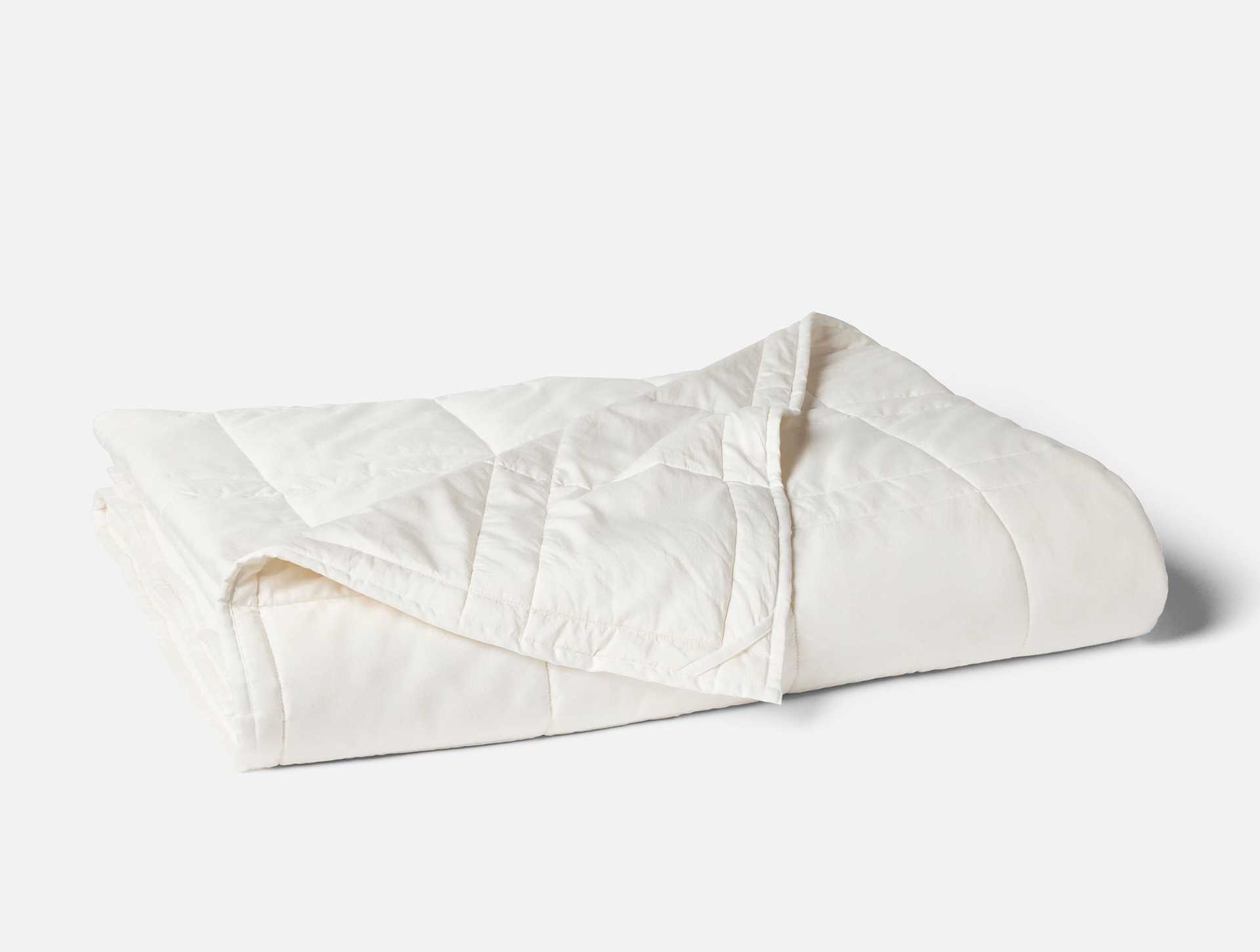
Bedding | A practical guide
Choosing a Luxury Comforter: Loft, Warmth, and Responsible Fill
A comforter can look cloud-soft and still be too warm for your room—or feel substantial without providing the kind of insulation you need. To find a layer that suits your nights, look beyond appearance. Fill power, total fill weight, construction, bedroom temperature, care requirements, and sourcing details all help tell the story.
Published November 17, 2026
There’s a particular pleasure in climbing into a bed that feels comfortably warm without feeling heavy or stuffy. The right comforter helps create that balance. But choosing one can be less straightforward than comparing a few product labels: terms such as “lofty,” “all-season,” and “premium down” describe different parts of the experience, and no single number determines whether a comforter will feel right to you.
Think of warmth as the result of several factors working together. The fill has insulating qualities, but its quantity matters, too. The shell and the way the comforter is stitched affect how the filling sits and how air moves through the bed. And the room itself—its temperature, drafts, humidity, and ventilation—can change how the same comforter feels from one home to another.
This guide breaks down the main details to compare, explains how to read common specifications, and offers a straightforward way to assess responsible-sourcing claims. The aim is not to find the “warmest” or most expensive comforter. It is to choose a layer that makes sense for your sleep preferences and your actual bedroom.
Start with your room, not the loft
A beautiful, lofty comforter may be a poor match for a warm bedroom. Likewise, a light layer that feels perfect in a well-heated home may leave a cold sleeper reaching for another blanket in a drafty room. Before comparing materials, consider the conditions you sleep in most often.
Note the approximate nighttime temperature in your bedroom, whether it changes much with the seasons, and whether you tend to feel warm or cool under covers. If you share a bed, take your partner’s preferences into account as well. One person’s cozy can be another person’s too-hot, which is why flexible bedding and separate layers can sometimes be more comfortable than one especially thick comforter.
Pay attention to what happens over several nights rather than judging by how a comforter feels for a moment in a showroom or when it first comes out of its packaging. Do you wake up warm and comfortable, or find yourself pushing covers aside? Do your feet get cold? Is the room cooler in winter but temperate for much of the year? These ordinary observations are useful evidence.
For a bedroom that stays mild, a lightweight comforter may offer enough warmth without unnecessary bulk. For a cooler room or someone who sleeps cold, a warmer option may be a better fit. If temperatures vary seasonally, a moderate layer that can be paired with a blanket may provide more flexibility than a very warm comforter used year-round.
Fill power is useful—but it is not a warmth score
Fill power is a measure commonly used for down. It describes the volume occupied by a given weight of down under a specified test method. In broad terms, higher fill power means the down can form more loft for its weight. That can make a comforter feel airy and substantial without requiring as much filling by weight.
It is tempting to read a higher fill-power number as a guarantee of greater warmth. That is not quite right. Fill power describes the lofting potential of the fill, not the complete performance of the finished comforter. The amount of fill, its distribution, the dimensions of the comforter, the construction, and the room’s conditions all matter. A high-fill-power comforter with a light fill weight may be designed to feel airy rather than intensely warm.
When comparing down comforters, read fill power alongside the stated warmth level and total fill weight, if the maker provides it. Check that you are comparing similar sizes: a larger comforter naturally needs more filling to cover its surface. A listed weight is most meaningful when you know the size and the intended use, such as summer, all-season, or winter.
Fill power is not a comparable rating for every material. Wool, down-alternative polyester, and other fibers have different characteristics, so a number used to describe down should not be treated as a universal measure of comforter warmth. For these fills, look for clear descriptions of construction, intended warmth, care, and materials instead.
Fill weight and warmth work as a team
Fill weight tells you how much filling is used in a particular comforter. In general, more fill can contribute to a warmer or fuller-feeling layer, but the relationship is not a simple one-to-one formula. A lofty fill can create more volume for less weight, while a denser material may feel heavier. The cover and construction also influence the overall hand and drape.
Some manufacturers offer the same comforter in summer, year-round, and winter weights. These labels are handy starting points, not standardized promises that every sleeper will experience the same level of warmth. Compare the specifications within a product range, and ask whether the stated warmth refers to a relative option in that range or to a clearly defined testing standard.
Weight against the body is another part of the experience. Some sleepers enjoy a light, buoyant layer that seems to float over the bed. Others prefer a comforter with more substance and a closer drape. These are personal preferences, not signs that one fill is inherently better. If possible, feel a sample or review the return and trial terms before making a long-term choice.
Construction helps determine whether warmth stays even
Even distribution is more than a tidy finishing detail. If filling shifts away from one area, the comforter can develop thinner patches and less consistent coverage. The type of stitching or chamber design helps determine how the filling is held in place.
Baffle-box construction uses internal walls between the top and bottom fabric to create three-dimensional compartments. The extra space allows down to loft within each box. A well-made baffle-box comforter can help maintain an even, fuller profile, though the quality of the materials and workmanship still matters.
Sewn-through or stitch-through construction joins the upper and lower shell fabrics directly at intervals. This creates separate sections and can be useful for lighter designs. Because stitching passes through the comforter, those lines may feel less lofty than the areas between them. That can be a sensible trade-off for a lighter layer, but it is worth considering if you are seeking substantial winter warmth.
Chamber construction describes compartments designed to contain filling and limit movement. The precise design varies between products. Look for practical details such as corner loops or ties, which can help secure an insert inside a duvet cover. A comforter that stays aligned is less likely to bunch into an awkward heap at the foot of the bed.
Construction does not replace the need to assess fill amount and warmth. It helps explain how a comforter may maintain its shape and distribute insulation, but it cannot make a lightweight fill behave like a winter-weight one.
The shell deserves a closer look
The shell is the fabric surrounding the fill. Cotton is a common choice, offered in different weaves and finishes. Percale often has a crisp, matte feel, while sateen is typically smoother. Neither weave is automatically right for everyone; the feel against the skin, fabric weight, and how the shell works with the fill are all worth considering.
A tightly woven, down-proof shell is designed to help keep small down clusters from escaping. Breathability matters, too: the shell is part of the sleep environment, so a fabric that feels clammy or too warm can affect comfort even if the fill is appealing on paper. Product descriptions may include thread count, but thread count alone does not establish overall quality. Fiber, weave, finishing, and durability contribute to the fabric’s performance.
Also check the construction details that suit your bedding setup. Corner loops can attach the comforter to a cover’s ties, reducing shifting. A washable cover acts as a protective layer against body oils and everyday soil, which may reduce how often the comforter itself needs cleaning.
Choosing between down and alternatives
Down is valued for its lightness and loft. It can provide warmth without the dense feel some sleepers dislike, and its performance depends on the quality and quantity of the fill as well as the comforter’s construction. It also requires care: washing and drying instructions vary, and a bulky comforter may need more room than a typical home machine provides.
Down alternatives can be a practical option for people who prefer not to use animal-derived fill or want a different care profile. These products may use polyester or other fibers, and their breathability, weight, texture, and ability to maintain loft vary. “Down alternative” is a broad category rather than one uniform material, so read the specific composition instead of assuming all alternatives feel alike.
Wool is another option. It has a distinctive feel compared with down and can be appealing to people seeking a natural fiber and a more substantial layer. Care is especially important: some wool-filled comforters are designed to be washable, while others may require different handling. Never assume a natural filling can be washed at home; follow the care label for the exact product.
For example, a Down-Alt Duvet uses recycled polyester fill with a TENCEL Lyocell shell and sewn-in chambers. It may suit someone looking for an alternative to down and a lightweight, cooling design. A washable wool-filled comforter, by contrast, combines a wool blend with an organic cotton sateen shell and is described as machine washable on a gentle cycle. These are different approaches, not interchangeable versions of the same comforter; the right choice depends on your preferred feel, warmth, and care routine.
How to assess responsible-sourcing claims
Responsible sourcing deserves attention, but a reassuring phrase on a label is only a starting point. Look for details that identify what is being certified, who issued the certification, and which part of the product it covers. A certification for the shell does not necessarily certify the fill, and a statement about a filling’s origin does not by itself explain animal-welfare practices.
When considering down, look for a named standard or certification and verify what its requirements cover. The Responsible Down Standard (RDS), for example, is a named standard associated with animal-welfare and supply-chain criteria. A label is most useful when the manufacturer clearly identifies the certified material and provides enough information to understand the claim. If a product description simply says “ethical” or “responsibly sourced,” look for supporting details rather than treating the wording as proof.
For textile claims, distinguish among organic content, chemical-safety testing, and environmental or social certifications. These labels address different questions. An organic certification may apply to a textile component or production process; a chemical-safety certification concerns testing for specified substances; an animal-welfare standard addresses a different part of the supply chain. No single certification necessarily covers every material and impact in a finished comforter.
Clear product information should make it possible to identify the fill, shell, country of origin where available, and any named standards. If those details are missing, that does not automatically prove a product is irresponsible, but it does mean there is less information available for an informed comparison. Ask focused questions, and be wary of broad environmental promises that have no supporting explanation.
Care can shape the long-term value
A comforter’s care instructions should fit your life. Some can be machine washed, while others call for professional cleaning. A care label takes priority over general advice, because different fills and shell fabrics can respond differently to water, heat, and agitation.
Using a duvet cover is a simple way to protect an insert from routine wear. Airing a comforter occasionally can help it feel fresh, provided the maker’s guidance allows it. When storing one between seasons, use a clean, breathable fabric bag if available. Avoid sealing a comforter away while it is damp, and do not assume that long-term compression is ideal for maintaining loft.
If home washing is permitted, check the machine capacity and drying directions. A comforter that is too large for the washer may not rinse properly, and insufficient drying can leave moisture in the filling. Down and other lofty fills may need particular attention to ensure they dry completely. If the instructions recommend professional cleaning, choosing a cleaner experienced with filled bedding can help avoid unnecessary damage.
Before buying, ask how often the item is expected to need cleaning and whether its care routine is realistic for you. A comforter that fits your budget but requires care you cannot conveniently arrange may not be the most practical choice over time.
A simple comparison checklist
When you have narrowed your options, compare them using the same questions. Looking at one feature at a time makes it easier to notice meaningful differences without getting swept up in impressive-sounding descriptions.
- Room conditions: Is your bedroom usually mild, cool, or drafty, and does that change with the seasons?
- Sleep preference: Do you prefer a light, airy layer or a fuller comforter with more presence?
- Fill details: What is the material, and, for down, what are the fill power and total fill weight for your size?
- Warmth options: Is the comforter offered in seasonal weights, and how does the maker describe each one?
- Construction: Does it use baffles, sewn-through sections, or chambers, and are there loops to secure it in a cover?
- Shell: What fiber and weave are used, and does the fabric feel suitable for your preferences?
- Sourcing: Are certifications named clearly, and do they apply to the fill, the shell, or another specific component?
- Care: Can you follow the washing or professional-cleaning instructions, including the drying requirements?
- Fit: Does the comforter match your bed and duvet cover dimensions, with enough coverage for how you sleep?
The best choice is the one that suits your nights
Luxury does not have to mean maximum loft, maximum fill power, or the heaviest winter option. For one person, it may mean a buoyant down comforter that feels warm without much weight. For another, it may mean a washable wool blend, a cooling down alternative, or a lighter layer that can be combined with a blanket when temperatures fall.
Start with the bedroom and the way you sleep. Then compare fill type, fill power where relevant, total fill weight, construction, shell, care, and sourcing information. No single detail can promise a perfect night, but a clear-eyed look at the whole comforter can help you avoid choosing by loft alone.
The most satisfying purchase is often the one that quietly does its job: staying evenly distributed, feeling comfortable in your room, and remaining manageable to care for. When those details line up with your preferences, the comforter becomes less of a specification sheet and more of what it should be—a dependable part of a restful bed.